


Wash a human hair wig every 8 to 10 wears — about every one to two weeks with daily wear, or four to six weeks if you rotate two or three. Use cool to lukewarm water, a sulfate-free shampoo from mid-length to ends, and air dry on a stand. Wash well, not often.
Every wash costs the hair a little life, because a wig has no scalp feeding it oil to recover with. The rest of this guide covers the five-step wash itself, what changes for curly and lace wigs, what to use when there is no wig shampoo in the house, and the habits that shorten a wig's life faster than washing ever will.
Human hair or synthetic: what actually changes?
Most wig-washing advice online is written for synthetic fiber, and following it on human hair leaves you with a dry, dull unit. The differences are worth knowing before you turn the tap on.
| Human hair wig | Standard synthetic | Heat-friendly synthetic | |
|---|---|---|---|
| Water temperature | Cool to lukewarm | Cold only | Cold only |
| Cleanser | Sulfate-free or clarifying wig shampoo | Synthetic-specific wig shampoo | Synthetic-specific wig shampoo |
| Conditioner | Yes, mid-length to ends | Light synthetic conditioner only | Light synthetic conditioner only |
| Detangling | Dry, before washing, wide-tooth comb or fingers | Fingers only, never while wet | Fingers only, never while wet |
| Drying | Air dry on a wig stand | Air dry on a stand | Air dry on a stand |
| Maximum heat | 250–300°F | None — the fiber melts | About 270°F |
| How often | Every 8–10 wears | Every 6–8 wears | Every 6–8 wears |
| Restyles after washing | Yes, takes a new set | No, returns to its factory curl | Yes, with heat |
The trade-off runs both ways. Human hair takes heat, color and a fresh set, which is why it lasts longer — but it also needs conditioning, because a wig has no scalp feeding it oil. Synthetic never needs conditioning and never loses its curl pattern, but it also can never be revived once the fiber is cooked.
How often should you wash a human hair wig?
Count wears, not days. A wig picks up product, sweat and oil per hour worn, so someone who wears one wig every day and someone who rotates three are on completely different schedules even though the calendar looks the same.
| How you wear it | Wash roughly every | Why |
|---|---|---|
| Daily, one wig, minimal product | 1–2 weeks | 8–10 wears comes round fast |
| Daily, heavy gel, mousse or holding spray | Weekly | Product build-up dulls the hair before dirt does |
| Rotating two or three wigs | 4–6 weeks each | Each unit reaches 8–10 wears far more slowly |
| Occasional or event-only wear | Every 8–10 wears, whenever that lands | Time in a box does not dirty a wig |
| Working out or swimming in it | After each session | Salt, chlorine and sweat all degrade the hair |
Four signs override the count: the hair feels sticky or coated, it will not hold a style, the curl pattern has gone limp, or it smells of anything. Any one of those means wash it now, whatever the tally says.
Should you wash a new wig before wearing it?
Not necessarily. A new human hair wig arrives clean, and washing it before the first wear spends one of your 8 to 10 washes on nothing. Wear it first if it looks and smells fine.
Two situations do justify a pre-wash. If the hair carries a chemical or storage smell, a single rinse and light condition clears it. And if the unit was shipped heavily coated in silicone to look glossy on the shelf, a clarifying wash strips that coating so your own products can actually absorb. A rinse without shampoo is a reasonable middle path in both cases.
How do you wash a human hair wig at home?
Five steps, about 20 to 30 minutes of hands-on time, plus several hours of air drying. Do it in the evening so the wig dries overnight.
- Detangle while dry. Work a wide-tooth comb or your fingers from the ends upward toward the roots, in sections. Never start at the roots — you drag every knot down into one solid mass. Wet hair stretches and snaps, so this step happens before any water touches it.
- Rinse with cool to lukewarm water. Hold the wig under the tap with the water running from the cap down toward the ends, in the direction the hair falls. Long units are easier under a shower head than a bathroom tap. Never bunch it up or scrub it against itself.
- Shampoo mid-length to ends. Put a coin-sized amount in your palms and stroke it downward through the hair. Keep it off the lace and the knots at the cap — shampoo loosens the knots that hold each strand in. Do not scrub, pile or twist. Rinse until the water runs clear.
- Condition the ends, not the cap. Start two to three inches below the cap and work down. Comb it through with your fingers, leave it one to five minutes, then rinse with cool water. Conditioner on the base loosens knots and leaves the cap greasy against your scalp.
- Blot and air dry on a stand. Press the water out with a towel — press, do not wring. Set the wig on a wig stand or mannequin head and leave it. Do not comb, brush or style until it is completely dry, and keep it out of direct sun.
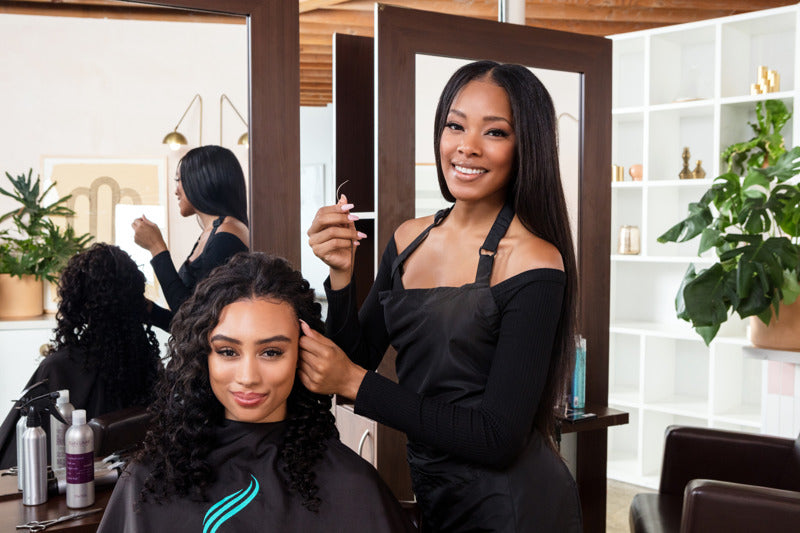
Does your wig type change how you wash it?
The five steps hold for every human hair wig. What changes is what you do before step one.
Headband and ready-to-wear wigs are the simplest, because nothing is glued down. There is no adhesive to dissolve and no lace to protect, so you can go straight to detangling. Mayvenn's current wig range is headband wigs, in 12", 16" and 20" for the curly and kinky textures and 14", 18", 22" and 26" for straight, body wave and deep wave.
Lace front and full lace wigs need the adhesive removed first. Work an alcohol-free or citrus-based lace remover along the hairline, wait for the bond to release, and lift the lace off rather than pulling. Pulling a bonded lace tears the knots out and thins the hairline permanently — and no wash routine repairs that.
Wigs with a closure or frontal sewn in follow the lace rule at the parting: keep shampoo off the knots, and never rub the parting area. The knots there are the whole illusion, and they are the first thing to go.
How do you wash a curly or kinky human hair wig?
Three changes to the routine. First, detangle in the shower with conditioner in rather than bone dry — tight curl patterns lock together when dry, and forcing a comb through breaks strands. Slip from a conditioner gives you a fighting chance.
Second, do not comb after washing. Combing a wet curly wig separates the curl clumps into frizz that will not re-form until the next wash. Scrunch the water out with a towel or a cotton T-shirt instead and let the pattern set as it dries.
Third, wash in sections. Clip a curly unit into three or four parts, wash each in turn, and you keep the sections from tangling into each other. It adds ten minutes and saves an hour of detangling.
Curly and kinky units also dry out faster than straight ones, because the oil that would normally travel down a strand has no scalp to start from and a longer, more twisted path to travel. Expect to condition more often than you would on a straight unit, and consider a leave-in between washes.
What can you use if you have no wig shampoo?
A sulfate-free shampoo made for color-treated hair is the best substitute, and for many people it is genuinely the better choice anyway. Color-safe formulas are built to clean without stripping, which is exactly what a wig needs.
A baby shampoo works in a pinch — gentle, but it can leave a film with repeated use, so treat it as a one-off rather than a routine. A clarifying shampoo is right when you have real build-up to cut through, but it is too stripping for regular washes.
What not to reach for: dish soap, laundry detergent, fabric softener and bar soap. All four appear in wig advice online, all four are formulated for surfaces that are not hair, and dish soap in particular strips a human hair wig of every trace of moisture in one wash. Fabric softener gives a brief silky feel and coats the hair so nothing absorbs afterwards.
How do you dry a wig without damaging it?
Air dry on a stand, every time. A wig stand or a mannequin head holds the cap in its intended shape while it dries, so the unit keeps its fit. Drying it flat on a towel or hung over a shower rail flattens and distorts the cap.
Give it time: several hours for a short unit, overnight for anything past 18 inches or with a dense curl pattern. Do not put it near a radiator or in direct sun to speed things up, and do not sleep in a damp wig.
If you genuinely must blow dry, use the cool setting with the nozzle six inches away and keep it moving. A human hair wig will take heat — 250 to 300°F is the working range — but heat on a wig is a spend, not a free action, because there is no scalp producing oil to recover from it. If you want curl without that cost, there is a heatless method that works on human hair.
What shortens a human hair wig's life fastest?
Washing is rarely the real culprit. In rough order of damage done:
- Sleeping in it. Friction against a pillow for eight hours does more tangling than a week of wear. A bonnet helps; taking it off helps more.
- Storing it loose in a drawer. The cap creases and the hair mats. A stand or the original box costs nothing.
- Hot water. It swells the hair shaft and loosens the knots at the cap in the same wash.
- Chlorine and salt water. Both are drying and both are cumulative. Rinse immediately if you cannot avoid them.
- Brushing while wet. Wet hair stretches before it breaks, so the damage is invisible until the ends start to look thin.
- Conditioner on the cap. A slow, quiet way to loosen every knot on the unit.
Do these six things right and the wash routine mostly takes care of itself. For what a well-kept unit should realistically give you, see how long wigs last.
Which routine fits how you wear yours?
- One wig, worn daily. Wash every one to two weeks, condition every wash, and take it off at night. This is the hardest wear pattern on a unit, so rotating in a second wig is the single best upgrade you can make — browse human hair wigs.
- You want the lowest-effort routine. A headband wig has no adhesive and no lace to protect, which removes the two steps most likely to go wrong. Start with headband wigs.
- You wear curly or kinky textures. Wash in sections, detangle wet with conditioner, never comb it dry. Curly units need more moisture than straight ones — see the ready-to-wear range.
- You would rather not wash a unit at all. Clip-ins come out at the end of the day and only need washing every 15 to 20 wears, because they are on your head for hours rather than all day. Look at seamless clip-ins.
- You are washing before coloring. Clarify first so the color takes evenly, and dry fully before you start — the method is in how to dye a human hair wig.
Wig washing questions, answered
How often should I wash my human hair wig?
Every 8 to 10 wears. With daily wear that lands at roughly one to two weeks; if you rotate two or three wigs, each one goes four to six weeks between washes. Wash sooner regardless of the count if the hair feels sticky, will not hold a style, or has lost its curl.
Can I use regular shampoo on a human hair wig?
Yes, if it is sulfate-free. A shampoo made for color-treated hair is the closest common substitute for wig shampoo and cleans without stripping. Avoid anything with sodium lauryl or laureth sulfate high in the ingredients list, and avoid dish soap entirely — it strips a wig dry in a single wash.
Do I need to wash a new wig before wearing it?
Usually not. A new human hair wig arrives clean, and an unnecessary wash spends one of its 8 to 10 washes for no benefit. Wash it first only if it has a chemical or storage smell, or if it is heavily coated in silicone, which blocks your products from absorbing.
Can you blow dry a human hair wig?
You can, but air drying on a wig stand is better. If you blow dry, use the cool setting, hold the nozzle about six inches away and keep it moving. Human hair takes heat at 250 to 300°F, but a wig has no scalp producing oil to recover from heat, so every pass costs it.
How do you wash a curly human hair wig without losing the curl?
Detangle wet with conditioner in rather than dry, wash in three or four clipped sections, and do not comb it after washing. Scrunch the water out with a cotton T-shirt and let it air dry untouched. Combing a wet curly unit breaks the curl clumps into frizz that will not re-form until the next wash.
Why does my wig feel dry after washing?
Most often the conditioner was rinsed too fast, the water was too hot, or the shampoo contained sulfates. A wig has no scalp feeding it oil, so it needs more conditioning than your own hair does. Leave conditioner on the full one to five minutes and add a leave-in between washes.
Should I wash the lace on a lace front wig?
Rinse it, but keep shampoo and conditioner off the knots. The knots at the lace are what hold each strand in place, and both products loosen them. Remove any adhesive with an alcohol-free lace remover before washing, and never pull bonded lace off dry.
Can I sleep in my wig if I just washed it?
No. Sleeping in a damp wig mats the hair and can leave the cap smelling musty. Even dry, sleeping in a wig causes more tangling than a full week of daytime wear. If you must, make sure it is completely dry, braid or pineapple the hair loosely, and wear a satin or silk bonnet.

